
By Han Cheng
Over the past decade, China’s Belt and Road Initiative (BRI) has become one of the most talked-about global projects in history. It’s been called everything from a bold vision for shared prosperity to a modern form of empire-building. Scholars, journalists, and policymakers across the world have tried to make sense of what the BRI really is — and what it means for the future of globalization.
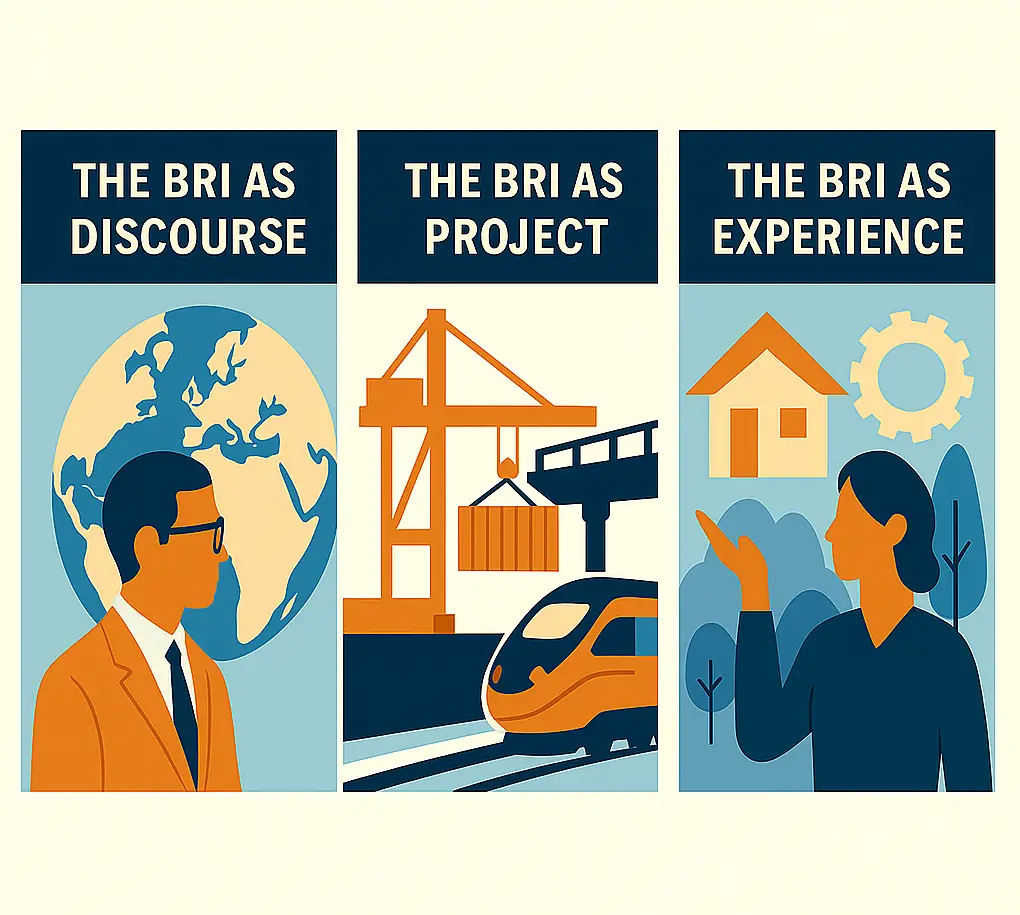
In reviewing both Chinese and English-language research on the BRI, three main ways of understanding it stand out: the BRI as discourse — a story China tells about itself and the world; the BRI as project — a network of investments and infrastructures reshaping global trade and power; the BRI as experience — a set of real, everyday effects on communities and environments around the world. As the BRI enters its second decade, we need a more complete way of analyzing it — one that looks across these three dimensions: the connections it creates, the layers of power it involves, and the histories it echoes.
The BRI as Story and Symbol
At one level, the BRI is a story — a powerful narrative about China’s place in the world. Chinese leaders often describe it as reviving the “Silk Road spirit,” linking Asia, Africa, and Europe through trade, cooperation, and shared destiny. The initiative evokes old maps and classical ideas from Western geopolitics — concepts like “heartland,” “rimland,” and “sea power” that once guided imperial strategy. By adopting and adapting these ideas, China signals its ambition to reconnect and reshape the world’s geography around its own center of gravity.
But the storytelling doesn’t end in Beijing. In Western media and academic circles, the BRI has sparked its own mirror-image narratives — some full of admiration, others of anxiety. Commentators in the U.S. and Europe often cast it as a “new Silk Road” of influence, or even as a geopolitical threat. These accounts sometimes revive the same racialized fears that shaped early 20th-century writings about the “yellow peril” — the notion that Asia’s rise might endanger the West’s dominance. In this way, the BRI isn’t just an economic or political project; it’s also a cultural battleground over who gets to imagine the world’s future.
The BRI as Global Project
Beyond words, the BRI is also a massive material enterprise. It reflects a shift in how global capitalism operates, especially after the 2008 financial crisis. Around the world, governments began turning to infrastructure-led growth — betting that roads, ports, and power plants could jumpstart development. For China, the BRI offered a solution to its own economic challenges: redirecting excess industrial capacity, expanding export markets, and securing access to resources and trade routes. It’s a way to move capital, technology, and influence beyond its borders — a “spatial fix” for a slowing domestic economy.
But the BRI isn’t just one country’s project. It involves a complex web of actors — state banks, development agencies, private companies, local governments, and international institutions. Together, they form what some researchers call state-coordinated investment partnerships, where business goals and political ambitions merge. These partnerships can bring much-needed infrastructure to developing regions — but they can also reproduce the same power imbalances and profit-driven dynamics seen elsewhere in the global economy.
The BRI as Lived Experience
On the ground, the BRI takes countless forms. A railway in Kenya, a power plant in Pakistan, a port in Greece — each project brings together local workers, global investors, and everyday communities in ways that are anything but uniform. In some places, BRI investments have created jobs, improved transport, and provided vital infrastructure. In others, they’ve sparked displacement, environmental harm, or social tensions. Scholars have found that the outcomes depend heavily on local politics — on who holds power, whose voices are heard, and how benefits and risks are distributed. These local dynamics reveal the BRI not as a top-down plan imposed by Beijing, but as a living process, constantly negotiated and reshaped on the ground. They also highlight the role of local activism — social movements that contest megaprojects and propose alternative visions of progress and “the good life.” Such movements remind us that development isn’t just about growth — it’s also about justice, identity, and belonging.
Looking Ahead: A Three-Dimensional Approach
Taken together, the BRI is not one thing, but many — a global story, an economic machine, and a lived reality. To understand it fully, future research and public discussion should look at it in three dimensions:
- Horizontal connections — how different BRI projects link regions, economies, and communities through flows of goods, people, and ideas.
- Vertical relations — how global forces (like finance and geopolitics) interact with local realities, shaping what happens in specific places.
- Historical trajectories — how today’s BRI echoes older patterns of empire, extraction, and uneven development — and how it might shape the next century’s world order.
As China’s Belt and Road enters its next phase, it’s no longer enough to ask whether it’s “good” or “bad.” The more urgent question is: how does it transform the world — materially, politically, and imaginatively — and who gets to shape that transformation?

The Author
Han Cheng is a Lead Researcher of ICSEP. He was an Assistant Professor at the Institute of Geographic Sciences and Natural Resources Research, Chinese Academy of Sciences. His ongoing project examines Global China as a critical intellectual project, focusing on the (re)emergence of Chinese development–area studies, world regional geography, and overseas ethnography. He received PhD from the University of Cambridge and worked as a policy researcher and investigative journalist before joining the academia.